
Vertical Blind Parts, Ven

This article provides a comprehensive overview of the key accessories for three of the most popular blind types, helping buyers and distributors identify the right components for their product lines.
Why Getting the Hardware Right Matters
Window covering hardware is not a category where guesswork pays off.
A blind system is only as reliable as its weakest component, and for distributors and manufacturers who supply across multiple product lines, having a clear understanding of what each blind type requires is essential for making accurate sourcing decisions.
Vertical blinds, Venetian blinds, and Roman blinds each have distinct hardware requirements, and mixing components between systems — or sourcing parts that are not correctly matched — leads to operational failures, warranty claims, and unhappy end customers.
This guide covers the key blind components for all three blind types so that buyers can approach supplier conversations with confidence.
Vertical Blind Parts: What Makes the System Work
A vertical blind system is built around a horizontal track from which individual fabric or PVC vanes hang and rotate.
The track itself is the foundation of the system, and the quality of the aluminium extrusion, the smoothness of the internal components, and the precision of the control end set all determine how the blind performs over time.
The control end set is the mechanism at one end of the track that drives the rotation and traversing of the vanes — it is one of the most important vertical blind parts to evaluate when sourcing a new system, as it is the component most subject to wear.
Other key vertical blind parts include the carriers, which hold each individual vane and allow it to slide along the track; the bottom weights or chains that keep the vanes hanging straight; and the vane savers, which are small plastic clips that prevent the vanes from tearing at the hanging hole.

| Part | Function |
|---|---|
| Aluminium track | Main structural rail the system hangs from |
| Control end set | Drives rotation and traversing of vanes |
| Carriers | Hold individual vanes and enable sliding |
| Bottom weights / chains | Keep vanes straight and prevent twisting |
| Vane savers | Protect vanes from tearing at hanger hole |
| End caps | Finish the track ends and protect internal parts |
Choosing the Right Vertical Blind Track
Not all vertical blind tracks are the same, and the choice between track profiles has practical implications for both installation and long-term performance.
The two main track profiles in common use are the 40x33mm track and the 40x25mm track, each of which requires its own compatible set of carriers, control end sets, and brackets.
Aluminium tracks are available in anodised or painted finishes, with anodised finishes offering better corrosion resistance and painted finishes providing more colour flexibility for projects where aesthetics are a priority.
When sourcing vertical blind parts for a new project or product line, always confirm which track profile is being used before ordering carriers and control mechanisms, as these are not interchangeable between profiles.
Venetian Blind Brackets: The Foundation of a Stable Installation
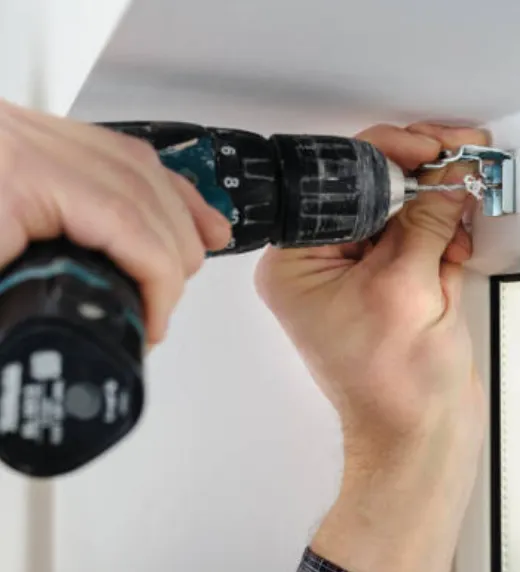
Venetian blind brackets are the mounting points that hold the entire blind assembly against the wall or ceiling, and their quality and correct specification are critical to installation stability.
The most common bracket types are face-fix brackets, which mount directly onto the wall surface above the window; top-fix brackets, which fix to the underside of a lintel or window reveal; and ceiling-fix brackets, which are used when the blind needs to be mounted overhead.
For wider Venetian blinds, centre support brackets are an essential addition — without them, the head rail will bow under the weight of the slats, causing operational problems and an uneven appearance.
Extension brackets are another important variant, used when the head rail needs to be positioned away from the wall surface to clear an architrave or other obstruction.
| Bracket Type | Mounting Position | Best Application |
|---|---|---|
| Face-fix / swivel | Wall face above window | Standard wall installations |
| Top-fix | Underside of lintel | Recessed window reveals |
| Ceiling-fix | Overhead surface | Ceiling-mounted installations |
| Centre support | Mid-point of head rail | Wide blinds over 120cm |
| Extension bracket | Offset from wall | Where clearance is needed |
Key Venetian Blind Components Beyond the Brackets
While venetian blind brackets are the most visible hardware element, a Venetian blind system contains several other components that are equally important to its performance.
The head rail is the horizontal housing at the top of the blind that contains the tilt mechanism and the ladder tape or cord supports that hold the slats in position. The tilt mechanism — usually a wand tilter or a cord tilter — controls the angle of the slats and is one of the components most subject to wear with regular use.
The ladder tape or ladder cord runs vertically through the slats and connects them to the bottom rail, maintaining even spacing and enabling the tilting action. The quality of this tape has a significant impact on the overall appearance of the blind, as worn or poorly made tape will cause the slats to hang unevenly.
The bottom rail completes the system and adds the weight needed to keep the blind hanging straight. For buyers sourcing blind components for Venetian blind assembly, the head rail, tilt mechanism, and ladder tape are the three elements that most directly affect the quality of the finished product.
Roman Blind Components: Understanding the System
A Roman blind operates on a fundamentally different principle from Venetian or vertical blinds — instead of slats or vanes, it uses a continuous piece of fabric that folds up in horizontal pleats when raised.
The key roman blind components are the track or batten at the top of the blind, the cord or chain control unit that drives the raising and lowering action, the cord rollers that guide the lift cords through the fabric, and the rings or eyelets stitched to the back of the fabric through which the lift cords run.
The track system is the most critical element to specify correctly, as it determines the control type, the mounting options, and the overall operation of the blind. Roman blind track systems are available in cord-controlled and chain-controlled variants, with chain control offering more consistent operation for heavier fabrics and larger blind sizes.
Sourcing quality roman blind components from a reliable supplier will ensure that the finished blind operates smoothly, hangs evenly, and maintains its appearance over time.
How to Build a Coherent Window Covering Product Line
For distributors who supply across all three blind categories — vertical, Venetian, and Roman — managing the component inventory effectively is as important as choosing the right products.
Each blind type requires its own set of blind components, and while there is some overlap in areas such as brackets and cords, most parts are not interchangeable between systems.
Working with a single supplier who covers all three categories is the most efficient approach, as it simplifies ordering, reduces the number of supplier relationships to manage, and makes it easier to maintain consistent quality across the product range.
A good window covering hardware supplier will also be able to advise on which components are most frequently needed as spares and help buyers build appropriate stock levels to support their after-sales service.
FAQ
Can vertical blind parts be used with any fabric type?
Vertical blind carriers and tracks are designed to work with vanes of specific widths — most commonly 89mm, 100mm, and 127mm. The fabric type, whether textile, PVC, or aluminium, does not affect the track compatibility, but the vane width must match the carrier specification.
What is the most commonly replaced Venetian blind component?
The tilt mechanism and the ladder tape are the two components most frequently replaced in Venetian blind systems. The tilt mechanism wears with regular use, and the ladder tape can fray or discolour over time, particularly in high-UV environments.
Do Roman blind components differ between cord-controlled and chain-controlled systems?
Yes. The control unit, the cord roller configuration, and in some cases the track profile differ between cord-controlled and chain-controlled Roman blind systems. Always confirm the control type before ordering replacement or assembly components.
How do I identify which venetian blind brackets are compatible with my head rail?
The key measurement is the head rail profile dimensions — the width and height of the head rail cross-section. Most brackets are designed for specific head rail sizes, and suppliers will be able to confirm compatibility if you provide these measurements.
Is it possible to source all three blind component types from a single Taiwan-based supplier?
Yes. Established Taiwan-based window covering hardware manufacturers typically carry a comprehensive range of blind components covering vertical, Venetian, and Roman blind systems, as well as curtain tracks and child safety accessories, making them an efficient single-source supplier for distributors managing multiple product lines.
/ / / /
本文將帶您深入解析在地調香的獨特工藝,並為您精選最值得私藏的小眾香水推薦,帶您領略那份從容不迫、絕不撞香的嗅覺美學。